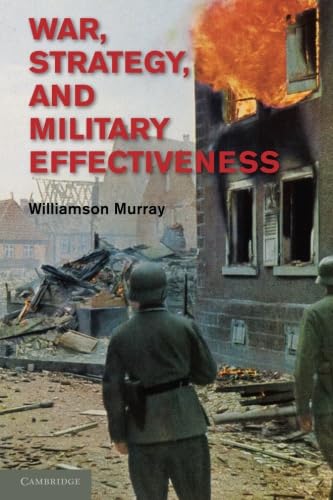
War, Strategy, and Military Effectiveness / Williamson Murray.
Material type: TextPublication details: New York: Cambridge University Press, 2013.Edition: First paperback edition 2013Description: vii, 332 Pages: 23 cmISBN:
 - 9781107614383
- U27 .M981 2013
| Item type | Current library | Collection | Call number | Copy number | Status | Notes | Barcode | |
|---|---|---|---|---|---|---|---|---|
 Books
Books
|
Zayed Military University General Stacks | General Collection | U27 .M981 2013 (Browse shelf(Opens below)) | C. 1 | Available | AED 132.40 | 23480 |
Browsing Zayed Military University shelves,Shelving location: General Stacks,Collection: General Collection Close shelf browser (Hides shelf browser)

|

|

|

|

|

|

|
||
| U22 .H117 2020 Rethinking Military Professionalism for the Changing Armed Forces / | U22 .R39 2018 Redefining The Modern Military: the intersection of profession and ethics / | U27 .B627 2022 A Short History of War / | U27 .M981 2013 War, Strategy, and Military Effectiveness / | U27 .M981 2024 The Dark Path : the structure of war and the rise of the west / | U27 .P291 2008 The Past as Prologue : the importance of history to the military profession / | U27 .R869 2024 Routledge Handbook of the Global History of Warfare / |
Machine generated contents note: 1. History and the future; 2. Thucydides and Clausewitz; 3. Clausewitz out, computers in, military culture and technological hubris; 4. Changing the principles of war; 5. Military culture does matter; 6. History and strategic planning, from Rome to 1945; 7. Thoughts on red teaming; 8. The distant framework of war; 9. The problem of German military effectiveness, 1900-1945; 10. Reflections on the combined bomber offensive; 11. The air war in the Gulf, the limits of air power; 12. Thoughts on British intellgence in WWII and the implications for intelligence in the Twenty-first century; 13. The meaning of World War II.
"This collection of articles represents Professor Williamson Murray's efforts to elucidate the role that history should play in thinking about both the present and the future. They reflect three disparate themes in Professor Murray's work: his deep fascination with history and those who have acted in the past; his fascination with the similarities in human behavior between the past and the present; and his belief that the study of military and strategic history can be of real use to those who will confront the daunting problems of war and peace in the twenty-first century. The first group of essays addresses the relevance of history to an understanding of the present and to an understanding of the possibilities of the future. The second addresses the possible direct uses of history to think through the problems involved in the creation of effective military institutions. The final group represents historical case studies that serve to illuminate the present"
There are no comments on this title.